Showing posts with label flesh. Show all posts

Friday, June 20, 2008

The charm in tragedy, God and flesh, injustice


Sometimes I run up against a really bad, dark mood that I don't much want to get myself out of, and I always wonder what kind of masochistic streak in me keeps me here. At times it is fairly abstract - I don't quite know what makes me so depressed - and at other times it's a concrete sadness, for something relevant and real. I think, though, that there are a number of reasons I (I'll speak for myself - please let me know if you can relate) find these dark moods so appealing.
-First, I feel I deserve it: humanity sucks. I am bad. And even if I haven't done anything very bad recently, take a look at the world - there is obviously something very wrong for little me to have so much and much of it to have so little.
-Second, it feels very much real: humanity sucks. That is a fact that I am very much aware of, that I see every day in myself, in others, in the state of affairs, on the news, in pictures, in my conscience, in the direct contrast of my beautiful God. So I think that getting lost in that gives me a certain sense of stability; that is something I know I am reasonable in. (Of course, [to me] logically rejoice is also reasonable, when considering God's awesome-nicity.) So it's easy to feel sad, it makes me feel connected and not lost inside of myself and substantial, stable and tied down and not as if I'm about to float away in all of my ignorance.
These two points run together very much.

I don't think it's just me. Maybe I have my unique reasons (though I doubt that - I think many though not all can relate), but it seems that there is evidence of this bizarre appeal of tragedy and depression all over the place, at least in the world in which survival is not the only priority a person can afford to worry about. Looking at the States for example - why do we continue to produce movies and music and literature that make us cry? We love to prize on the relatability of tragedy to all humans; heartbreak and divorce and disappointment run as deep in the entertainment sphere (ironic the use of the word 'entertainment') as they do in the real world. More and more people are found sucked into themselves, with self-abuse and depression and drugs rampant. I guess it's also fascination with the abomination. Or perhaps this is partly the origin of fascination with the abomination.
It's interesting to me all the charm we find in tragedy.


Instinct lies in the gut. The most 'savage' (closest to animal?) of our human traits resides in our bodies. I find it interesting that also inextricably tied to our flesh is contrition, festering and eating away at our hearts and our guts - no doubt a God-borne sentiment if ever there was one. This to me is a distinct reminder of God as man.

And also evidence to His continuing use of material, Creation, flesh as tools in bringing us closer to Him. Which is, according to the Anglican perspective, what the Eucharist is. The lack of faith in the strange reality of Christ's presence in the Eucharist seems to me to be based in an underlying perspective that downplays material and Creation and God's involvement in that, that ultimately doubts the man of Christ, the word made flesh, the skin and bone and heart and blood of our Almighty, corpus Christi. God tied himself so irreparably to the flesh and humanity when He made Himself man - why is it utterly unbelievable that He would do that still today in a continued effort to bring us to Him? I don't mean to open discussion as to the validity of the Anglican perspective on the Eucharist (though if you'd like to, I won't stop you), only to offer this as some sort of chipping away at the standard of reasonable doubt that seems to have been built up against it.


It seems to me that the most valid and true injustice in the world is the suffering of children - they are innocent, they are blameless, they have potential. Humans are evil, but adults are more capable of knowing better. And as our bodies age (and our hearts grow colder), it seems we are only fighting fate in battling physical pain or deterioration. If the bodies were meant to grow so old they wouldn't decay so.

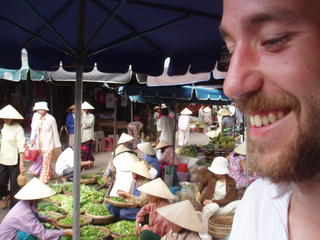
The picture is from our 2005 trip to Viet Nam - I miss it very, very much right now. I also miss the clear and poignant perspective I had and had to share, right in front of me, in Viet Nam.


Currently reading:
Harry Potter y la Cámara Secreta
The Count of Monte-Cristo
The Twilight Series

Currently listening to:
new Coldplay cd!
Abracadavers, The Classic Crime
this guy - jwoo. He's awesome!

Saturday, September 1, 2007

pride, music, love is real, tied to the flesh

Pride is an enormous subject with me. I'm gonna start with a definition. Ambgtr (maybe I should start using nicknames like companionableills -- I know I'd have fun with that) can attest for the semantics problems we've had because we didn't bother to give our personal definitions.

When I speak of pride (most often, at least, and when I'm speaking of it here), I'm referring to pride the sin. Pride the sin is believing that you are good without God. It's trying to be God without Him. It's attributing your talents or skills or hard work or whatever it may be to yourself, rather than to Him who gave them to you.
(It's horribly ludicrous, in other words.)

The Devil is the epitome of pride. He works with pride, through pride; he is pride. Pride is something I have really struggled with, and, to me, it is the root of all sin. A man is greedy because he wants more things, and he wants more things very often because he wants more than his neighbor, and he wants more than his neighbor because he believes himself to be the best. It gets more complex than that, but that is only one example.
In short, if we didn't believe ourselves above having God in complete control, then He would be in control. If He was in control, we wouldn't sin any longer.

So, um, that was an introduction to pride? I originally was going to say a lot about it but it's 12:22am three days later and I haven't finished my homework and this post is long enough anyway. Next post, probably.


This is a blog from the Andrew McMahon of Jack's Mannequin and Something Corporate, and it's what I want from my music. I am very, very picky. This might sound very cliche and not at all unique, but I look for music that is real and sometimes I have trouble finding it.
Music is a bit of heaven, and a powerful emotional device, and a means of motivation, and a method of catharsis, and whatever you want to take from it, really. It can be damaging. I am very careful with my music.


Sometimes I feel things in my chest and know that they're not necessarily lasting. It's not until I feel them in my gut that I know they're there for good. Those are the things that tug at my heartstrings. That's what is my core.

I was talking to someone I really look up to the other night and he expressed a feeling he had, before conversion, of emptiness. He felt it inside of him, physically. He'd spend time around strong Christians and sensed a core, stability that he was missing.
God is my rock.

All of this is such great evidence to me that we are truly tied to the flesh. I am not a materialist or empiricist and really, philosophically, often lean more towards idealism (I suppose technically I'm a dualist maybe?), but my faith tells me that our reality is, in fact, inherently real. I cannot prove this -- my TOK (theory of knowledge - a required class for the IB program) classmates, or at least the ones that discuss things with me, know what I mean. It is a matter of faith and so I take it to be true. God tells me that He made all things and they are good. I take that to mean that my body and the things around me and the world I live in are useful tools in knowing God, becoming closer to Him, loving Him and loving His people, and I believe that the things God put on this earth can be and are used by Him to reach us. Music, food, water. The question is, to what extent? I'm not actually going to get into this yet, though.


I'm sure we've all heard DesCartes's "Cogito ergo sum. [I think, therefore I am.]". (What a coincidence because after writing this I read this week's TOK chapter and it talked about this.) Love proves my existence to me the same way Descartes doubting proved his (he may doubt that everything is real, but there has to be a doubter and so, he exists). I love people, and so something is being loved. I can't technically prove the existence of that something, but someone is certainly acting upon that something, no matter how little basis for doing it that someone has. I guess this is part of what I was trying to say at the beginning of this post.

On a kind of irrelated (I'm gonna get way ahead of you all and point out to myself that this isn't a word) note, love (and, really, emotion in general, but I like talking about love) is much more real, philosophically, to me than anything else. In TOK we talk about the ways of knowing (emotion, language, perception, thought) and really, the only one I really trust is emotion. I won't go into why the others are generally very unreliable (maybe another time) but emotion is something, really, that is pretty reliably outside of ourselves. I'm getting myself kind of tied up here because all my ideas for the effects of emotion rely pretty much on perception or language, but for the most part emotion is not really part of us. Though we might have control over emotions, the very fact that we might want or have to have control over them indicates that they are separate ('outside', I think, is not the right word) or not of ourselves. Emotions uniquely make us act certain ways -- it's not like when I see a tree and so decide to walk around it (and so the tree made me do something), where I could very easily not walk around that tree. I made a conscious decision to walk around the tree. I didn't really have to, but I, myself, decided to and made me do it. Maybe, though, I was feeling particularly masochistic that day and so instead of walking around the tree I ran into it quite painfully, probably. If I didn't have those bad feelings of myself, that emotion, I'm sure I would have avoided that tree. Or maybe I was feeling bad about myself but I thought about it and realized that walking into a tree was an awfully ridiculous thing to do, so I went around it. My point is, I still thought about it. If I didn't have that emotion, I wouldn't have given it a second thought at all. I would have walked around the tree because that's generally what common sense would have me do. But when I have this emotion, it requires some thought or control to walk around the tree when I otherwise would do it automatically.

All I'm really trying to say here is that emotion is pretty reliably (not provably [haha! didn't think that was a word], I know) not of ourselves. (But this is a ridiculously knotted argument because it may in fact rely entirely on perception [that is, sense-data, for those of you who read the TOK book]. How sad.)

This is not to say that emotion is always correct (not the word I want, really) though. Example: Once, I had a dream that somebody I knew did something really, really stupid and irritating. I woke up mad at him, and couldn't shake that anger for about a day and a half. I even talked to him about it. Completely unbased (what is that red squiggly line doing there?!) emotion.


Maybe, though, I'm mistakenly considering 'perception' as a way of knowing (which, to me, mostly includes language) and our 'sense-data' (we have sensations of color, texture, heaviness -- the color, texture, weight itself is a sense-datum) to be the same thing.
Well shooot. That switches things around a lot, I guess.


So I went maybe a little wikipedia/link crazy on this one. Maybe not. I also have discovered that my vocabulary sucks. In the normal sense but also in the I've-got-to-stop-making-up-words sense.
This is one of my more rambly (another red squiggly line :[ ), stream-of-consciousness posts and I'm going to apologize to and virtually pat on the back anyone who did me the favor of reading through it. Maybe not as high a substance-to-word ratio as desirable, but I'd still like to hear what you have to say.

Currently reading:
Catch-22, Joseph Heller

Current music:
Between the Trees
Notre-Dame soundtrack
First Time, by Lifehouse
Twenty-Four, Switchfoot
Globes and Maps, Something Corporate